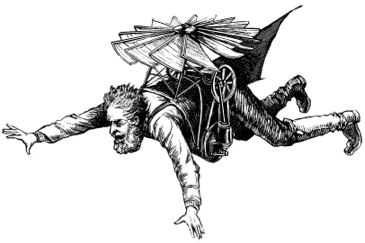
"El menesteroso de una ciencia, el que siente la profunda necesidad de la verdad, se acercará cauteloso al saber ya hecho, lleno de suspicacias, sometiéndolo a crítica; más bien con el prejuicio de que no es verdad lo que el libro sostiene; en suma, precisamente porque necesita un saber con radical angustia, pensará que no lo hay y procurará deshacer el que se presenta como ya hecho. Hombres así son los que constantemente corrigen, renuevan, recrean la ciencia.".
The person devoted to a science, who feels a profound need for truth, will approach established knowledge cautiously, full of suspicion, subjecting it to scrutiny—often with the presumption that what the book asserts is untrue. In essence, because he needs to build knowledge from within, driven by existential angst, he will reject what is handed down as truth and attempt to discern it for himself. Such individuals are the ones who continually correct, renew, and recreate science."
Looking for Challenges
From October 2026 I will be doing a post-doc with Nagatani sensei at the University of Tsukuba. Besides of his current projects, we want to start a new collaboration to develop some of my ongoing projects (contact us for more information).
I am also open to new R&D opportunities in Japan or the European Union, but it must be a challenging opportunity, something that gives me the satisfaction of solving complex problems, and a potential contribution to society.
Click on the title of each section to show/hide the content:
Engineering and R&D experience
I earned a Master's degree in Automatic and Electronic Systems Engineering from the University of Seville. During the final years of my studies, I was an undergraduate researcher at GRVC, a leading robotics group with a strong international reputation in aerial and unmanned systems. My work -and Master's thesis- led to a patent, and I continued at GRVC as a graduate researcher to complete the design.
Later, I moved to Austria to work as a mechanical design engineer at FACC, an aeronautical company. The role was both challenging and rewarding, focusing on the design of mechanisms and interior components for business jets. I was recognized as an outstanding mechanical designer, and after saving some money, I decided to pursue my lifelong dream of moving to Japan. Two of my designs, listed in my recommendation letter, were later patented by the company.
I joined the wearables start-up 16Lab in Yokohama as Vice President of Engineering. The company was developing a smart ring, and my role involved creating methods and algorithms to define its interactions. I added five successful patents to my portfolio and contributed to the ring winning the Innovation Award at CEATEC Japan 2015 in the Home Entertainment category. Once the product was fully developed and the company shifted its focus to business development and commercial integration, I left my position at 16Lab to develop my own robotic designs.
I began working with Kim-sensei at Iwate University, where I had full freedom to pursue my own designs while contributing to research on forestry technologies and methodologies aimed at helping elderly populations in rural areas safely cut trees. As for my designs, I applied for two new patents: a robot joint (granted) and a high-ratio gearbox (failed due to a similar patent from Toyota). A few years later, Kim sensei started a new company in Korea, and his laboratory at Iwate University closed. I decided to stay in Iwate, where I was getting married.
I started a family in Iwate and joined my wife in running her cram school, where we taught science, robotics, and programming to children. Life in Iwate was peaceful, and I was able of sharing a lot of time with my daugther, but we wanted to give her a better educational environment and I wanted to continue developing my robotic designs, so after two years we decided to move to Tsukuba.
I joined Tsukuba University as a PhD student to develop my designs as part of my doctoral research in collaboration with the japanese National Institute of Advanced Industrial Science and Technology (AIST). However, as my research group began a collaboration with the Moonshot R&D program, I shifted my focus to inflatable robot arms, specifically designs that could be fabricated on-demand in a future moon station. After only one semester I already had few working prototypes, but we realised that the main bottleneck for large pneumatic robots was the number of hoses neceasary to operate all the actuators, so I shifted again my research topic to pneumatic logic circuits. My first paper on pneumatic logic was presented at ICRA 2025, and an additional paper was published in IEEE Access some months later. The main contribution of my PhD are the Multi-channel Pulse Sequence systems (MCPS) that are the first addressing systems able to control any number of distributed pneumatic devices through a limited number of lines. An additional contribution was the set-reest valve, a novel type of membrane valve that resembles the logic of an electronic SR NAND latch. I will graduate on September 2026.
Additional information
| CV | My CV, focused on Engineering Experience |
| GRVC | Experience as R&D Engineer at GRVC |
| FACC | Experience as Design Engineer at FACC |
| 16Lab | Experience as Vice President of Engineering of 16Lab |
| KimLab | Experience as Researcher at Iwate University (Under construction) |
| AIST | Experience as Researcher at AIST (Under construction) |
| Projects | Previous patents and ongoing projects |
Skills
|
|
Recommendation Letters
| Recommendation by GRVC | Recommendation by my research tutor at GRVC (Seville) |
| Recommendation by FACC | Recommendation by my former boss at FACC (Austria) |
| (Available under request) | Report as Vice President of Engineering at 16Lab (Tokyo) |
| (Available under request) | Recommendation by my former sensei at Iwate University |
Links
| For professional recommendations and networking | |
| GRVC | Robotics Research group of the University of Seville |
| FACC | Composites company in Austria |
| 16Lab | Wearables company in Tokyo |
| Sky Ocean Technology | New company of my former sensei at Iwate University |
| Field Robotics Research Team | Research team at the Intelligent Systems Research Institute, AIST |
| Field Robotics Lab | Nagatani sensei Laboratory at the University of Tsukuba |
| rafael@ferrin.org | |
Missing something? Let me know! :) |
|